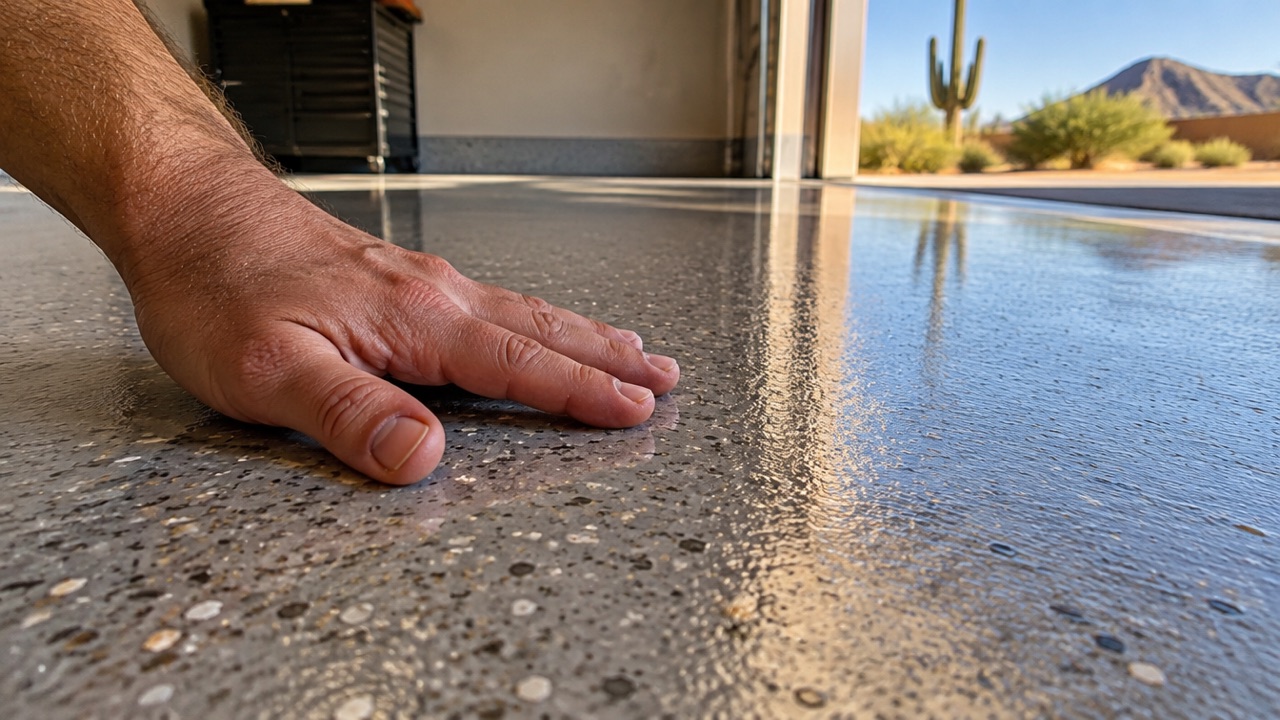
Why does my epoxy floor feel rough? In most cases one of four things is behind it: anti-slip aggregate in the topcoat, flake edges poking through a thin clear coat, a coating that skinned over too fast in the heat, or dust and debris that landed in the wet film. Only some of these are defects, and almost all are correctable without tearing the floor out. If you are in a dispute with an installer or unsure what you are looking at, our epoxy floor repair service covers diagnosis and correction, and this guide helps you work out which cause you have first.
1. First Question: Is the Texture Deliberate or a Defect?
Deliberate texture is even, consistent and agreed in advance, while a defect is patchy, sharp or unexpected. The quickest way to tell is to look at the floor in low, raking light and run your hand across several areas.
| What you notice | Likely meaning |
|---|---|
| Fine, even grit across the whole floor | Deliberate anti-slip aggregate |
| Sharp points that catch a sock, mostly over flake | Flake edges not buried by the clear coat |
| Dimpled surface like an orange skin | Coating skinned over before it levelled |
| Random specks or bumps in patches | Dust, debris or insects in the wet film |
| Rough only where a thin coat sits over coarse concrete | Surface profile showing through |
Compare the floor against what you were sold. Look at the sample, the quote and any written description, and check whether a non-slip finish was mentioned. A floor that matches the sample is a different conversation from one that does not. The cause matters because each one is corrected differently.
2. Cause One: Anti-Slip Aggregate You Did Not Ask For
Many installers add anti-slip aggregate to the topcoat as a standard step, which makes the floor feel gritty by design. It is useful where water is expected, but it surprises owners who assumed a smooth, glossy finish.
Aggregate is measured by the grip it gives. ANSI A326.3 sets 0.42 as the commonly cited dynamic coefficient of friction for level interior floors expected to be walked on wet, and an aggregate-loaded topcoat is how a coating reaches that number. Our guide to slip resistance, COF and non-slip additives explains what each additive does and where it belongs, so this post leaves that choice to it.
- It is correct when: The area gets wet, such as a pool deck, kitchen, wash area or entry, or you asked for it.
- It is a problem when: It was never discussed, it is uneven, or it is sharp underfoot on a residential garage sold as smooth.
- The fix: A smoothing clear coat can bury some of the texture, but it also reduces grip, so decide how much traction you want to keep.
3. Cause Two: Flake Not Fully Encapsulated by the Clear Coat
A flake floor feels like sandpaper when the clear coat is too thin to bury the flake edges, leaving them proud of the surface. The flake is broadcast into a wet base, and the clear coats that follow have to be thick enough to cover every chip with a smooth film.
This is the most common cause of a gritty feel on a new flake floor, and it usually shows up as sharp points that catch a sock or a bare foot. It is a build problem, not a flake problem, and thickness is the measure. Our guide to epoxy floor thickness in mils covers how the clear coat adds to the build and how to check it.
- Inspect: Look for flake edges breaking the surface, especially at larger chip sizes.
- Abrade: Lightly sand or screen the surface to knock down the high points and give a new coat something to grip.
- Recoat: Apply an additional clear coat thick enough to bury the edges.
An additional clear coat over an abraded surface normally resolves the problem without touching the system underneath, which is why it is a much smaller job than a reinstall.
4. Cause Three: The Coating Skinned Over Too Fast in the Heat
On a hot slab the surface of a coating can skin over before the material underneath has levelled, leaving an orange-peel or gritty texture. The coating cures from the surface down, so a fast skin traps the roller marks and ripples before they can flow out.
Phoenix makes this a real risk. Air temperature in the shade tells you little, because slab temperature can run well above it, especially near an open door or in afternoon sun. Experienced crews schedule around slab temperature, start early, and use products matched to the conditions. Our guide to installing epoxy in Phoenix summer covers the timing, and the cure chemistry is in our guide to polyaspartic same-day cure.
| Heat-related sign | What caused it |
|---|---|
| Orange-peel dimples across the floor | Surface skinned before leveling |
| Visible roller marks or lap lines | Material started to set before it was rolled out |
| Gritty feel on a thin clear coat | Fast cure left no time for the film to flow |
5. Contamination, Dust and Insects in the Wet Film
Anything that lands in a wet coating gets locked in, and a garage with an open door is exposed to desert dust, leaves, hair and flying insects. These show up as random specks or small bumps in patches rather than an even texture across the whole floor.
- Dust and debris: Airborne dust settles into the film, especially on windy days or when grinding dust was not fully removed beforehand.
- Insects: Bugs landing in the wet clear coat leave small bumps or dark specks, more often at dusk with the door open.
- Prep residue: Dust left on the slab after grinding shows through as a rough film.
- Overspray and drips: Splashes from neighboring work dry as raised dots.
Spot defects like these are usually sanded flat and re-coated locally rather than redone across the whole floor. Good crews control the work area, vacuum the slab thoroughly and manage doors and airflow while the coating is wet.
6. A Fourth Cause: Surface Profile Showing Through a Thin Coat
A coating that is too thin over a coarsely prepared slab can feel rough because the concrete's profile telegraphs through the film. The prepared slab is deliberately rough so the coating can grip, and a thin coat follows that texture instead of burying it.
Surface profile describes how rough a prepared slab is. ICRI 310.2R is the standard that defines concrete surface profile on a numbered scale, and ASTM D4417 is a related method for measuring profile, though it is written for blast-cleaned steel rather than concrete. The point for an owner is simple: the rougher the profile, the more coating it takes to leave a smooth surface. A thin, single-coat system over a heavily profiled slab will feel gritty even when nothing was applied wrongly.
The fix is more build, usually an additional coat or a clear coat over a lightly abraded surface. Our guide to concrete grinding and surface profile explains how profile is set and matched to the coating that follows.
7. What Each Cause Costs to Correct
Most of these defects are corrected with an abrade-and-recoat rather than a replacement, so cost depends on the cause and the area. Our repair page guides resurfacing a sound existing coating at $6 to $12 per square foot, with localized problems varying by how much has to come off and the condition of the substrate.
| Cause | Usual correction | Scope |
|---|---|---|
| Unwanted aggregate | Smoothing clear coat over a scuffed surface | Whole floor |
| Flake edges proud of the clear | Abrade and add a clear coat | Whole floor |
| Heat-skinned orange peel | Sand level and recoat | Whole floor or affected areas |
| Dust, debris or insects | Spot sand and local recoat | Individual spots |
| Profile showing through a thin coat | Add build coats | Whole floor |
We give a free written quote once we have seen the floor, because the cause decides the scope. If the floor is peeling or lifting rather than just rough, that is a different problem, covered in our guide to epoxy floor bubbling and peeling.
8. Raising It With Your Installer
Ask what caused it before deciding anything, and keep the conversation about the cause rather than blame. A good installer can usually tell you straight away whether the texture is aggregate, flake, heat or debris, and what they would do about it.
- Document it: Take photos in raking light and a short video of your hand on the surface.
- Compare to the sample: Check the quote, sample and any message that described the finish.
- Ask for the product and coats: Which clear coat, how many coats and whether aggregate was added.
- Check the warranty: Our guide to garage epoxy warranties explains what is typically covered.
- Get the fix in writing: Scope, timing and who pays, before work starts.
If the installer will not engage, a second opinion from another contractor costs little and tells you whether the problem is cosmetic or structural. Our guide to choosing an epoxy contractor covers the questions that help you avoid it next time. For the garage system itself, our epoxy garage floor Phoenix page describes what a correctly installed floor includes.
9. Prevention: What to Ask Before the Next Install
Most rough finishes trace back to a question nobody asked before the work started. Five questions at the quote stage prevent nearly all of them.
- Will the topcoat include aggregate, and how coarse? Ask for a sample panel that shows the finished feel.
- How many clear coats go over the flake? More than one is common on a full-broadcast floor.
- What slab temperature do you work to? A crew that measures the slab, not the air, is managing the heat risk.
- How will you control dust and insects? Door management and vacuuming before the final coat matter.
- What is the target thickness? A thin system over a rough profile will feel rough.
10. Frequently Asked Questions
Get a Free Quote for Your Floor
Tell us what the floor feels like and get a written scope for correcting it once we have seen it.