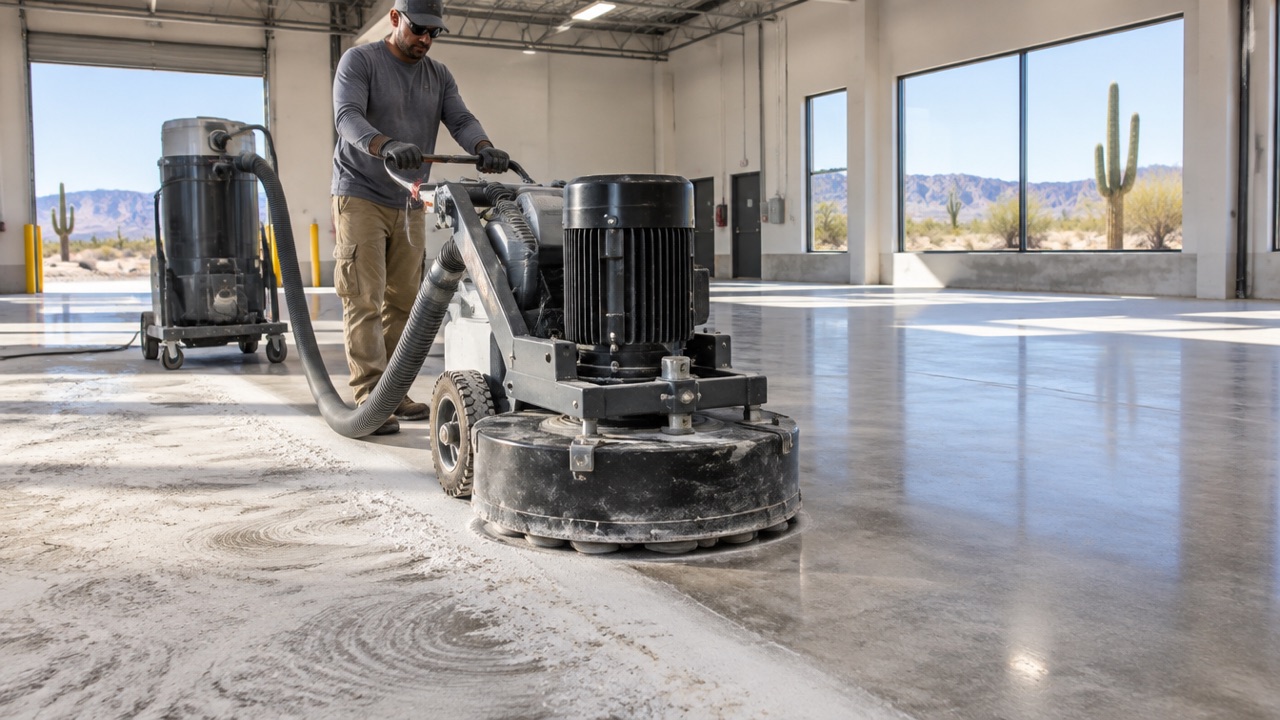
Concrete grinding in Phoenix, AZ is the mechanical removal of the weak top layer of a slab, plus any old coating, glue or mastic, using rotating diamond tooling and vacuum dust extraction. It leaves a clean, profiled surface that a coating can bond to, and on some jobs it is the entire scope rather than a first step. Property owners and general contractors pricing a grinding scope usually want to know what it removes, what profile it leaves and when it is the right tool, and that is what this guide covers. If you want the finished sealed floor that follows grinding, see our concrete grind and seal service.
1. What Concrete Grinding Actually Removes
Grinding removes whatever sits between the sound concrete and the coating that comes next: laitance, sealers, old coatings, adhesive residue and surface contamination. It takes off a thin layer, usually a fraction of a millimeter to a few millimeters, depending on tooling and the number of passes.
| Surface condition | What grinding does | Typical effort |
|---|---|---|
| Bare, clean slab | Opens the pores and sets the profile | Light, one or two passes |
| Laitance or weak surface | Removes the soft top layer | Moderate |
| Old sealer or thin coating | Strips the film back to concrete | Moderate to heavy |
| Thick epoxy or urethane | Removes with coarse or PCD tooling | Heavy |
| Tile mastic or glue | Scrapes and grinds the adhesive away | Heaviest |
Laitance is the part many owners have never heard of. It is a weak, chalky layer of cement paste and fine particles that rises to the surface during finishing, and a coating applied over it fails when the laitance lets go from the slab beneath. Washing does not remove it, which is why grinding is the standard preparation rather than pressure washing or sweeping.
2. Concrete Surface Profile: Matching CSP to the Coating That Follows
Concrete surface profile, or CSP, is a numbered scale of surface roughness defined in ICRI Guideline 310.2R, and the coating you plan to apply determines which number you need. Thin coatings want a fine profile, and thick troweled systems need a coarser one to grip.
| Coating type | Typical CSP | Common method |
|---|---|---|
| Sealers and thin-film coatings | CSP 1 to 3 | Diamond grinding |
| Standard epoxy and polyaspartic systems | CSP 2 to 3 | Diamond grinding |
| Self-leveling and high-build systems | CSP 3 to 4 | Grinding or shot blasting |
| Troweled mortar systems | CSP 4 to 6 | Shot blasting or scarifying |
The coating manufacturer's technical data sheet states the profile required, so the data sheet and the prep method have to be chosen together. A profile that is too smooth gives a weak bond, and one that is too rough can telegraph through a thin coating as visible texture. We cover how preparation connects to the whole job in our guide to preparing a garage for epoxy, and how it ties to garage floors specifically on our epoxy garage floor Phoenix page.
3. Diamond Tooling, Grit Progression and Why It Changes the Result
The diamond tooling and the order of grits decide how fast the work goes and what the finished surface looks like. A coarse grit removes material quickly, and finer grits refine the surface, so a good crew moves through a planned progression rather than using one tool for everything.
- Metal-bond diamonds: The workhorse for removing coatings and opening the surface. Harder concrete usually takes a softer bond, and softer concrete a harder bond, so the tool wears at the right rate.
- PCD tooling: Polycrystalline diamond tools made for stripping thick coatings, mastics and adhesives that would clog a standard segment.
- Coarse to fine grits: Coarse grits, in the 16 to 30 range, remove material. Mid grits, around 40 to 80, refine the scratch pattern.
- Resin-bond diamonds: Used at finer grits where the surface will be sealed, stained or polished and a smooth scratch pattern matters.
Tooling choice also affects how well a slab suits polishing later. A slab that will be polished needs a deliberate grit progression from the start, and its age and mix affect the result, as described in our guide to slab age and polishability.
4. Dust Containment and Working in an Occupied Building
Grinding is done with vacuum extraction attached directly to the machine, so most of the dust is captured at the tool rather than released into the air. This matters on every job and is a legal requirement on commercial work, because concrete dust contains respirable crystalline silica.
OSHA 1926.1153 covers respirable crystalline silica in construction, and its table of specified controls for grinders calls for dust collection with a HEPA filter or equivalent controls. Crews also manage worker exposure, keep the work area contained and clean up with HEPA vacuums rather than sweeping, so the building around the work stays usable.
- Machine-mounted extraction: A HEPA vacuum connected to the grinder shroud, running whenever the tool runs.
- Containment: Plastic barriers or closed doors to keep dust out of adjacent areas.
- Respiratory protection: Provided to the crew where exposure requires it.
- HEPA cleanup: Floors are vacuumed, not dry swept, at the end of each shift.
Work in an occupied building is normally staged by area and often at night or on weekends, so tenants and staff lose one zone at a time. Ask any contractor for their silica exposure control plan, since a crew without one is a risk to your building and to your liability.
5. Grinding Versus Shot Blasting Versus Acid Etching
Grinding is the preferred method for most coating prep because it gives a controlled profile with little dust and little mess. Shot blasting suits large open areas that need a coarser profile, and acid etching is a weaker, less reliable method that is rarely accepted for commercial work.
| Method | Profile | Best for | Drawback |
|---|---|---|---|
| Diamond grinding | CSP 1 to 3 | Most coating prep, edges, tight spaces | Slower on very large open slabs |
| Shot blasting | CSP 3 to 5 | Large open floors, coarser profile | Needs a separate machine for edges |
| Scarifying | CSP 5 to 9 | Heavy removal, rough surfaces | Aggressive, leaves a very rough surface |
| Acid etching | CSP 1 to 2 | Light cleaning only | Uneven, leaves residue, weak bond |
Acid etching is still sold as a cheap shortcut, but it leaves residue that must be neutralized and rinsed, it produces an uneven profile and it does not remove sealers or coatings. Most data sheets for industrial and commercial coatings do not accept it. For what goes onto the slab after grinding and when it needs refreshing, see our sealer types and recoat guide.
6. When Grinding Alone Is the Finished Scope
Grinding alone is the finished scope when the owner needs the surface flattened, cleaned or cleared of coating, with nothing applied afterward or with another contractor applying it. These jobs are priced and scheduled as grinding projects rather than as the first line of a coating estimate.
- Removing a failed coating: Stripping old epoxy, paint or sealer before a different trade installs new flooring.
- Leveling trip hazards: Grinding down raised slab edges at joints and cracks to remove a hazard.
- Adhesive and mastic removal: Taking up old tile or carpet glue ahead of new floor coverings.
- Prep for others: Preparing a slab to the CSP a flooring or coating installer specifies.
- Exposed concrete: Cleaning and lightly grinding a slab that stays as a plain, honest concrete finish.
Grinding flattens minor height differences and removes surface damage, but it cannot repair structural cracking or a slab that has settled. Those need to be assessed and fixed before any surface work, which is why a walkthrough comes first. The scope, the profile target and the dust control plan should all be written down before the grinder starts.
7. What Grinding Uncovers About Your Slab
Grinding often reveals problems that a visual inspection of a dirty or coated slab cannot, which is one reason a good scope allows for discovery. The surface that appears after the first pass tells you what the slab really is.
- Hairline and shrinkage cracks: Common in Phoenix slabs and usually cosmetic, but they need routing and filling before a coating goes over them.
- Oil and grease saturation: Staining that grinds out partially but can leave contamination below the surface that needs treatment before priming.
- Patch repairs and different concrete: Old repairs grind at different rates and can show as color or texture changes in the finished surface.
- Voids and honeycombing: Pockets and pinholes that open up as the surface is cut and need filling.
- Moisture: A slab that feels dry can still emit vapor. It should be tested before a coating is chosen, not after.
None of these make grinding the wrong choice. They are reasons to agree in advance how discoveries are handled, whether by change order, a unit price for crack repair or an allowance, so a surprise on day one does not become a dispute on day three.
8. What to Put in a Grinding Scope
A grinding scope should state what is being removed, the profile target, the dust control method and what the finished surface must pass. The more specific it is, the easier it is to compare bids fairly.
| Scope item | What to specify |
|---|---|
| Area and condition | Square footage, slab age, known coatings or adhesives |
| Profile target | CSP number from the coating data sheet |
| Method | Grinding, blasting or both, with edge work noted |
| Dust control | HEPA extraction and containment per OSHA 1926.1153 |
| Repairs | Crack and joint repair included or priced separately |
| Schedule | Work hours, phasing and cleanup requirements |
Price follows how many passes the slab needs and what is being removed, so a clean bare slab grinds quickly and a floor with old mastic or a failed coating can take several times longer for the same square footage. We quote after a walkthrough rather than publishing a single number.
9. Frequently Asked Questions
Free Slab Walkthrough
Walk your slab with our crew and get a written grinding scope, profile target and dust control plan.