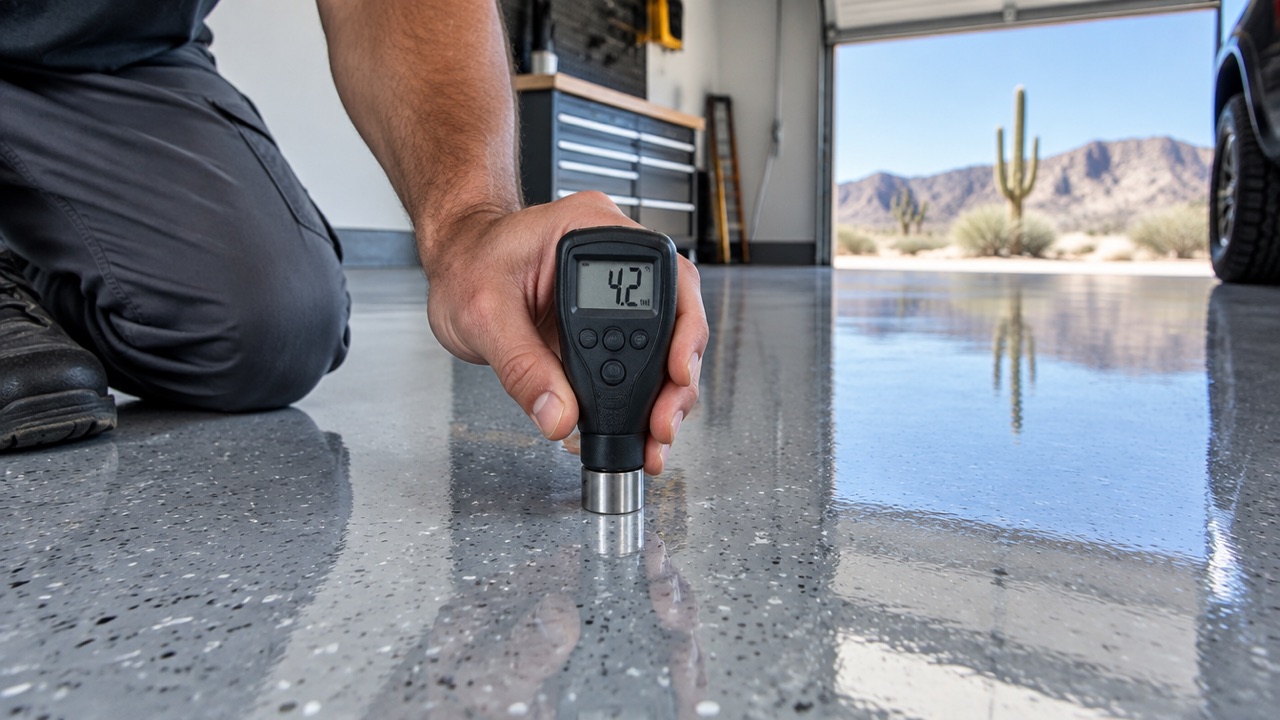
How thick should an epoxy floor be? For a residential garage with a flake system and a clear topcoat, roughly 20 to 40 mils once everything is on; a thin 3 to 5 mil roll-on coating is a different, lighter product. Thickness is the measurable behind most price differences between two quotes, which is why it is worth understanding before you compare them. This guide explains what a mil is, what each range buys and how to confirm what was installed, starting from our epoxy garage floor Phoenix service.
1. What a Mil Is and Why Coatings Are Sold by It
A mil is one thousandth of an inch, or about 25 microns, and coatings are specified in mils of dry film because the dry thickness is what determines how the floor wears. A sheet of printer paper is roughly 3 to 4 mils thick, which gives you a feel for the scale.
Wet and dry thickness are not always the same. Solvent-based and water-based products shrink as the carrier evaporates, so the wet film is thicker than the dry film. A 100 percent solids epoxy or polyaspartic loses very little as it cures, so wet and dry thickness are close, which is one reason these systems are favored for floors.
The useful link between thickness and material is coverage. One US gallon of a 100 percent solids coating covers about 1,604 square feet at 1 mil, in theory and before any waste. Divide 1,604 by the thickness you want and you get the coverage per gallon: roughly 160 square feet per gallon at 10 mils, and about 80 at 20 mils. That arithmetic is how a quote can be checked later.
2. Thickness Ranges by Application, From Thin-Film to Troweled
Thickness ranges from a few mils for thin-film coatings to a quarter inch or more for troweled systems, and the right range depends on the traffic, the slab and the finish. The figures below are typical ranges and vary by product, so the manufacturer's data sheet is the real authority.
| System | Typical dry film | Typical use |
|---|---|---|
| Thin roll-on or sealer coat | 3 to 5 mils | Light foot traffic, low abuse |
| Two-coat solid color epoxy | 10 to 20 mils | Garages, shops, storage areas |
| Full flake system with clear topcoat | 20 to 40 mils | Residential and light commercial |
| Self-leveling high-build epoxy | 40 to 125 mils (up to 1/8 inch) | Showrooms, heavier commercial use |
| Troweled mortar system | 1/8 to 1/4 inch and up | Forklift, impact and chemical areas |
The loading, not the square footage, sets the build. A garage that holds two cars needs far less than a plant floor with steel-wheeled traffic. For the heavy end, see our guide to industrial epoxy flooring in Phoenix.
3. Why a Flake Floor Measures Thicker Than a Solid Color
A flake floor is thicker than a solid color floor because the flake is broadcast into a wet base coat until the surface will take no more, and then clear coats are needed to bury it. The flake and the clear that covers it account for most of the added build.
- Base coat: The pigmented epoxy that holds the flake in place.
- Broadcast: Flake thrown into the wet base until it rejects more, which builds texture and thickness.
- Scrape and sweep: The loose excess is removed so the surface is even.
- Clear coats: One or more clear coats bury the flake and seal it, typically with a UV-stable topcoat such as polyaspartic.
That is why a flake system lands in the 20 to 40 mil range while a plain two-coat solid color floor often sits near half that. For the system itself, including finishes and options, see our epoxy flake flooring page, and for choosing flake colors and blends, see our guide to garage floor colors, flake and patterns.
4. How Thickness Shows Up on a Quote and What to Ask For
A quote that lists only a total price tells you nothing about thickness. A useful quote lists each layer, the product, the number of coats and either the target mils or the material quantity, so you can compare it with another bid line by line.
| Ask for this | Why it matters |
|---|---|
| Each layer and product named | Shows what is actually going down |
| Target mils per layer or total | Lets you compare builds directly |
| Material quantity in gallons | Allows a coverage check after install |
| Flake coverage (full or partial broadcast) | Partial broadcast is thinner and shows more base color |
| Topcoat type and number of clear coats | Drives UV stability and wear |
| Surface prep method | Grinding sets the bond that thickness depends on |
Two quotes for the same square footage can differ by half simply because one builds 12 mils and the other 30. For help weighing quotes beyond thickness, our guide to choosing an epoxy contractor in Phoenix covers the other questions to ask, and our epoxy flooring cost guide covers the price ranges themselves.
5. Verifying Dry Film Thickness After Installation
You can verify thickness three ways: by measuring during application, by measuring a finished test area and by checking the material used against the area covered. The right method depends on the substrate, and concrete is not like metal.
ASTM D7091 and SSPC-PA 2 are the standard references for gauge measurement of coating thickness, but they are written for coatings on metal, where magnetic and eddy-current gauges work. A slab is not magnetic, so on concrete installers rely on other methods.
- Wet film gauge during application: A notched comb pressed into the wet film shows the applied thickness while it can still be corrected.
- Ultrasonic gauge on a finished test area: Some ultrasonic gauges measure coating thickness on non-metal substrates.
- Coverage check: Divide the gallons used by the square feet covered, and compare it with the 1,604 square feet per gallon at 1 mil figure.
- Test cut: A small cut in an out-of-sight spot shows the layers and allows a direct measurement with a magnified scale.
Because the best methods all depend on records, asking for the product quantities and the target mils in writing on the quote is what makes verification possible later. Without them, there is nothing to measure against.
6. When Thicker Is Genuinely Better and When It Is Upselling
Thicker is better when the traffic, the slab or the chemicals demand it, and it is upselling when it adds material that does nothing for service life. The question to ask is what problem the extra thickness solves.
- Genuinely better: Heavy vehicle or forklift loads, rough slabs that need fill and leveling, harsh chemical exposure and areas with impact.
- Often upselling: Extra build coats on a lightly used residential garage with a sound, smooth slab.
- Potentially harmful: A very thick system over a slab with unresolved moisture, which can trap vapor and raise the risk of blistering.
Phoenix adds practical limits. High slab temperatures shorten working time, so thick builds are applied in controlled passes, and moisture should be tested to ASTM F1869 or ASTM F2170 before any heavy build goes down. A floor that is the right thickness for its use, over a sound and dry slab, outperforms a thicker floor over a problem. Our guide to epoxy over tile, paint or sealer covers the substrate side of that.
7. A Worked Example: Checking a Two-Car Garage Quote
You can sanity-check a quote with one line of arithmetic: divide 1,604 by the target mils to get the theoretical coverage per gallon, then divide the floor area by that figure. The result is the minimum material the job should use before waste.
| Step | Calculation | Result |
|---|---|---|
| Floor area | Two-car garage, about 440 sq ft | 440 sq ft |
| Base coat target | 12 mils | 1,604 / 12 = about 134 sq ft per gallon |
| Base coat quantity | 440 / 134 | About 3.3 gallons before waste |
| Clear coat target | 8 mils | 1,604 / 8 = about 200 sq ft per gallon |
| Clear coat quantity | 440 / 200 | About 2.2 gallons before waste |
Real jobs use more than these theoretical figures, because rough concrete absorbs material, edges and mixing lose some, and flake adds its own volume. Still, a quote that lists far less product than the arithmetic suggests is a quote that cannot deliver the mils it claims. Ask the contractor to show the quantities and the target thickness side by side.
8. Reading a Data Sheet: Solids, Spread Rate and Recoat Window
A product data sheet states the numbers that thickness claims rest on: the percentage of solids by volume, the recommended spread rate and the window for applying the next coat. These three lines tell you whether a quote's build is realistic.
- Volume solids: A 100 percent solids product leaves almost everything you apply on the floor. A product with 50 percent solids leaves half, so the same wet film dries to about half the thickness.
- Spread rate: The manufacturer's coverage in square feet per gallon at a given mil thickness, which is the figure to compare with the quote's quantities.
- Recoat window: The time within which the next coat bonds chemically. Missing it means abrading the surface before continuing, which affects schedule and sometimes cost.
- Pot life and temperature limits: Phoenix slab temperatures in summer shorten working time, which is why heavy builds are applied in controlled passes.
If a contractor will not name the product or share the data sheet, that is a reason to be careful. The data sheet is what lets you check their claims against the manufacturer's own numbers.
9. Frequently Asked Questions
Get a Free Quote With the Build Spelled Out
Ask for the layers, mils and material quantities in writing so you can compare quotes fairly.