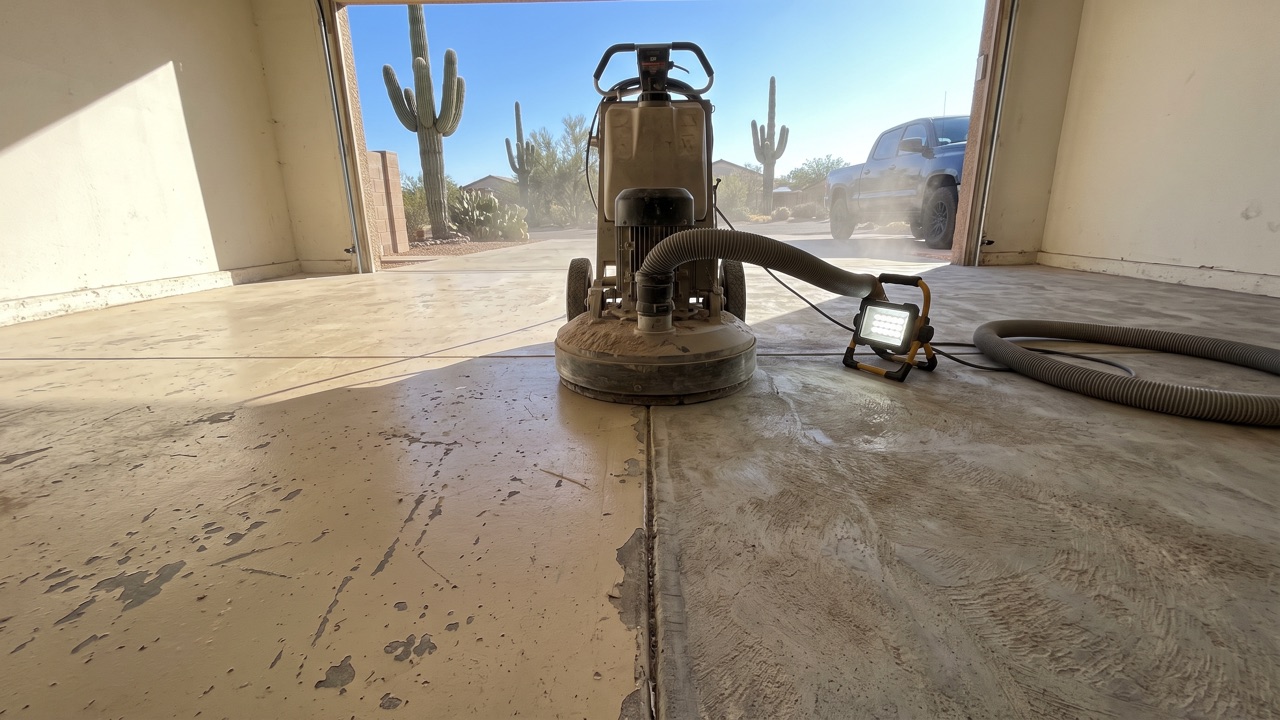
Can you epoxy over existing tile or paint? Sometimes, but usually not directly: epoxy only performs as well as the layer under it, so tile, paint and sealers generally have to be removed or ground back to sound concrete first. A fully bonded old epoxy floor is the main exception. If your floor is failing or you are not sure what is under the surface, our epoxy floor repair service covers diagnosis and resurfacing, and this guide gives you a verdict and a simple test for each type of surface.
1. The One Rule That Governs Every Substrate Question
A coating is only as strong as the weakest layer beneath it, so the bond between epoxy and a sound, clean, profiled concrete surface is what decides whether the floor lasts. Every substrate question comes down to whether that weak layer can be left in place or has to go.
Two references are worth knowing. ASTM D4541 measures pull-off adhesion, which is how strongly a coating is stuck to what is under it, and ICRI 310.2R describes the surface profile that grinding or blasting should leave for the coating to grip. A floor that fails in service almost always failed at a bond line, not inside the epoxy itself.
| Existing surface | Coat directly? | Usual path |
|---|---|---|
| Ceramic or porcelain tile | Rarely | Remove tile and grind, or level over fully bonded tile |
| Vinyl tile and old adhesive | No | Test first, then remove and grind |
| Painted concrete | No | Grind or shot blast the paint off |
| Sealed concrete | No | Grind the sealer off |
| Sound, bonded epoxy | Yes, after abrading | Abrade and recoat |
| Failing or peeling epoxy | No | Remove the failed areas first |
2. Epoxy Over Ceramic Tile: When It Works and When It Does Not
Epoxy can go over ceramic tile only when every tile is fully bonded, and even then it is rarely the better choice. Grout lines show through as visible depressions, and one loose tile will lift the coating with it.
The test is simple. Tap each tile with a coin or the handle of a screwdriver. A solid, high-pitched sound means the tile is bonded, and a hollow, dull sound means it has debonded from the slab. Any hollow tile disqualifies the floor until it is removed or reset.
- Bonded and flat: Possible, but the grout lines need filling or a leveling layer to hide them, which adds a step and cost.
- Any hollow tile: Remove it, grind the thinset flat and patch the void before coating.
- Glossy glazed tile: Needs aggressive abrasion for the coating to key in, which risks cracking tiles.
- Heavy-use areas: Garages and workshops are better served by removing the tile and coating the slab.
Vinyl composition tile needs a warning of its own. Older vinyl tile and the black adhesive under it can contain asbestos, so have suspect material tested before anything is scraped or ground. Never dry-grind material of unknown content.
3. Epoxy Over Painted Concrete
Epoxy should not go directly over painted concrete, because paint is a weak layer between the coating and the slab. The new floor is only as strong as the paint's grip on the concrete, and most garage and floor paints do not grip well.
You can check how well paint is holding with a tape test, which is the idea behind ASTM D3359. Press a strip of strong tape firmly onto the paint, rip it off quickly and look at the tape. Paint on the tape means the paint is poorly bonded, and even clean tape does not make it a safe base for epoxy.
Paint is removed mechanically by diamond grinding or shot blasting until bare concrete shows. Chemical strippers and sanding by hand are slower and leave residue, so professional prep is almost always grinding, which also sets the surface profile. Our guide to concrete grinding explains what it removes and what profile it leaves.
4. Epoxy Over a Sealed Slab and the Water Drop Test
You can tell whether a slab is sealed with a water drop test: drops that bead on the surface mean a sealer is present, and drops that soak in and darken the concrete within a minute mean the slab is open and porous. Either result still leads to grinding, but the test tells you what you are working with.
| Test result | What it means | What to do |
|---|---|---|
| Water beads and sits | Film-forming sealer or coating present | Grind the sealer off to bare concrete |
| Water darkens in under a minute | Open, porous concrete | Grind lightly to profile and clean |
| Slow, patchy absorption | Mixed or worn sealer | Grind the whole floor, not just the beading areas |
Film-forming acrylic sealers sit on top of the concrete and block a coating from bonding, so they have to come off. Penetrating sealers go into the concrete rather than sitting on it, but they also reduce its absorbency, which can interfere with adhesion. Grinding handles both. What goes on afterward depends on the system, covered in our guide to preparing a garage floor for epoxy.
5. Recoating Over an Existing Epoxy Floor
A new epoxy or polyaspartic coat can go over an old epoxy floor if the old coating is sound and fully bonded everywhere. The surface is abraded so the new coat has something to grip, and any area that is lifting, bubbling or delaminating has to come off first.
- Inspect the whole floor: Look for lifting at edges, bubbles, tire marks where the film pulled up and hollow-sounding spots.
- Test adhesion: A tape test or a small scratch test will show whether the coating is bonded.
- Remove failed areas: Grind out anything loose and patch back to a sound edge.
- Abrade the rest: Scuff or lightly grind the surface so the new coat can key in.
- Apply the new coat: Recoat only after the surface is clean, dry and free of contamination.
Recoating is common for sun-damaged or worn floors where the bond is still good. If the existing coating is peeling or bubbling, the cause has to be found before anything new goes down, and our guide to epoxy floor bubbling and peeling covers the usual causes. A new coat will not fix a bond failure.
6. What Removal Costs When the Answer Is No
Removal costs vary with how many layers there are, how well they are stuck and how much dust control and disposal the job needs. A coating over a failing substrate usually costs more in the end, because it fails with the substrate and the removal still has to happen.
- Number and type of layers: Tile on thinset, paint over sealer or several old coatings take longer than a single thin layer.
- Adhesive and mastic: Stubborn adhesive can take several times longer to grind than a bare slab.
- Area and access: Tight spaces and stairs need hand tools rather than a walk-behind grinder.
- Dust control and disposal: Vacuum extraction and haul-away are part of the work, especially when silica or suspect materials are involved.
- Repairs after removal: Cracks, pits and thinset scars need filling before the coating.
We do not publish a single removal figure because those factors move it too much, and a firm number only comes from seeing the floor. The real comparison is removal against a coating that fails and has to be removed anyway. For a quote on the whole job, see the full process in our epoxy garage floor Phoenix service page.
7. Tests You Can Run Yourself Before You Call
Four simple checks tell you most of what a contractor would find on a first visit, and none of them needs special equipment. Run them in a few spots across the floor, not just one, since conditions can change from one end of a garage to the other.
- Tap test for tile: Tap each tile and listen for any hollow, dull sound.
- Tape test for paint and coatings: Press strong tape down firmly, pull it off fast and check for paint or coating on the tape.
- Water drop test for sealers: Place a few drops on bare concrete and watch whether they bead or soak in.
- Plastic sheet test for moisture: Tape a plastic sheet about two feet square to the slab, seal the edges and leave it for a day. Condensation under the sheet points to moisture coming up through the concrete, which the ASTM F1869 and F2170 tests then measure properly.
These checks do not replace professional testing, but they help you describe the floor accurately and avoid surprises. Photos of the results are useful when you ask for a quote.
8. Phoenix Factors That Change the Answer
Phoenix conditions add two checks on top of the substrate tests: moisture in the slab and heat on the surface. Both can ruin a floor that otherwise looks fine.
- Slab moisture: Slabs near irrigation or without a vapor barrier can emit moisture even in a dry climate. ASTM F1869 and ASTM F2170 are the standard tests, and they should be done before any coating decision.
- Heat: Slab surface temperatures in summer can shorten working time and affect cure, so installers schedule around the day's temperature.
- Sun exposure: Old sealers and paint near open doors often degrade from UV, which weakens their bond over time.
- House age: Older homes are more likely to have layered floors, old adhesives and past repairs under the visible surface.
None of these rule out a new floor. They explain why a quick look is rarely enough and why the honest answer to most substrate questions is to test first and grind second.
9. Frequently Asked Questions
Get a Free Quote for Your Floor
Tell us what is on your floor now and get a written scope for the prep and coating it needs.