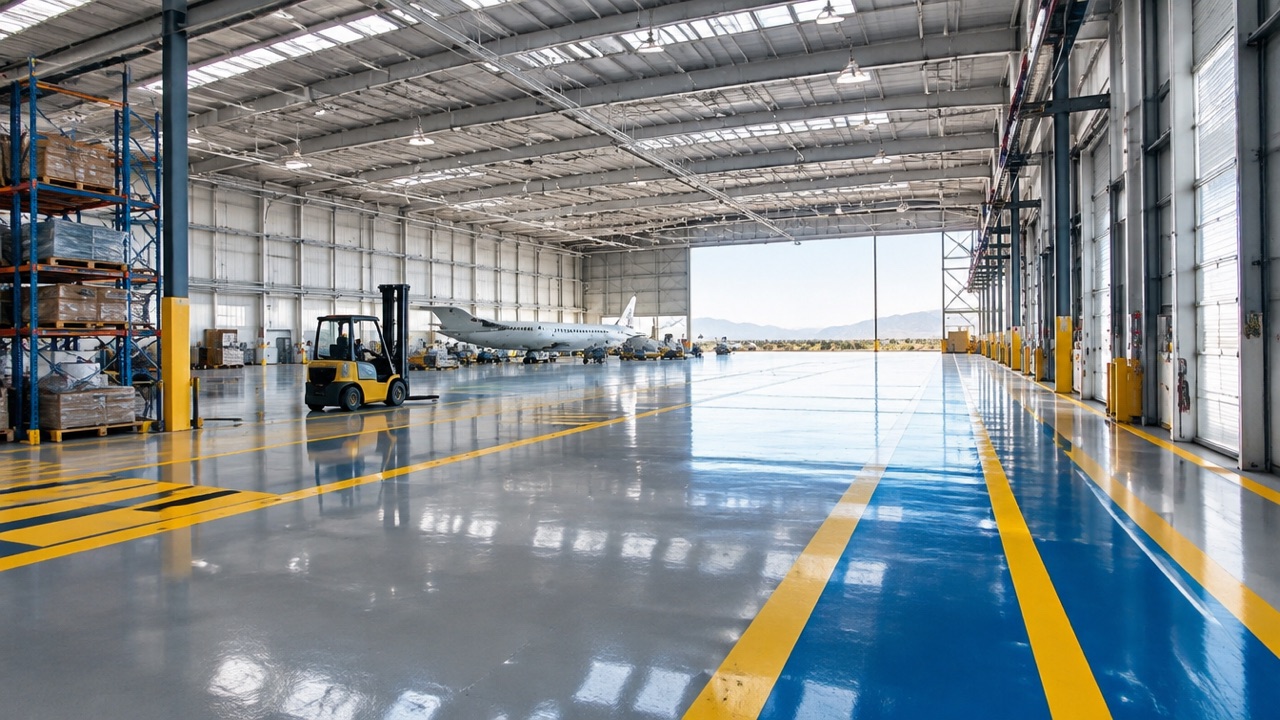
Phoenix epoxy striping is the application of colored, durable lines and marks on a coated floor to define aisles, work zones, hazards and equipment locations. In a warehouse, plant or hangar, those lines are part of the safety system as much as the floor itself, and they last longest when they are planned with the coating rather than added afterward. This guide covers what markings are required, the colors in common use, inlaid versus surface-applied lines and how a facility should plan them, starting from our warehouse epoxy flooring service.
1. What Floor Markings Are Required Versus Recommended
Only a small part of facility marking is a legal requirement: OSHA expects permanent aisles and passageways to be appropriately marked wherever mechanical handling equipment is used. Everything beyond that, such as color-coded work cells, pedestrian walkways and equipment zones, is good practice rather than a rule.
| Marking | Status | Purpose |
|---|---|---|
| Permanent aisles and passageways | Expected by OSHA where equipment is used | Define traffic lanes for forklifts and people |
| Fire equipment and emergency stops | Required clear access, marking recommended | Keep access unobstructed |
| Pedestrian walkways | Recommended | Separate people from vehicles |
| Storage and staging zones | Recommended | Keep pallets out of aisles |
| Hazard zones | Recommended, often required by policy | Flag machine, pit and edge hazards |
The governing language sits in OSHA 1910.176(a), which requires sufficient safe clearances for aisles, loading docks, doorways and turns where mechanical handling equipment is used, and in the walking-working surface rules that expect aisles to be kept clear and in good repair. Neither sets a color, which is why a site standard matters.
ADA parking and van-accessible stall marking is a separate subject with its own dimensions, covered in our guide to parking garage ADA striping, so this guide stays on interior facility markings.
2. OSHA Aisle Marking Widths and Color Conventions
OSHA does not set a single line width or aisle width in the general industry rules, so most facilities size aisles to their widest equipment plus clearance and use a standard line width of about 2 to 4 inches. The color convention is a site decision, usually based on ANSI Z535.1 safety colors, and consistency across the site matters more than any one palette.
| Color | Common use | Notes |
|---|---|---|
| Yellow | Aisles, traffic lanes, caution | The most widely used floor marking color |
| Red | Fire equipment, emergency stops, danger | Keep access areas clear |
| Orange | Machine and warning zones | ANSI Z535.1 warning color |
| Green | Safety equipment, first aid | Eyewash, safety showers |
| Blue | Information, staging, work cells | Often used for materials and tooling |
| Black and yellow stripes | Physical hazards | Edges, low clearances, pits |
Aisle width itself follows the equipment. A common rule of thumb is to allow the widest vehicle or load plus clearance on each side, and to make walkways wide enough for two people to pass. Racking layout and clearances are covered in our guide to warehouse racking and floor flatness, which owns that subject.
Write the standard down. A one-page marking plan that lists each color, its meaning and its width keeps contractors, new supervisors and later repainting consistent, and it is the document an auditor or insurance inspector will ask for first.
3. Inlaid Striping Versus Surface-Applied Striping
Inlaid striping is applied under the clear topcoat and lasts as long as the floor, while surface-applied striping goes on top and is cheaper and easier to change. The right choice depends on how permanent the layout is and how hard the traffic lane is driven.
| Factor | Inlaid Under Topcoat | Surface-Applied |
|---|---|---|
| Durability | Lasts with the floor | Wears with traffic |
| Layout change | Hard, needs grinding | Easy to remove and move |
| Install | Part of the coating sequence | Can be added any time |
| Best for | Fixed aisles, permanent zones | Layouts that change |
| Refresh cycle | Rarely needed | Every couple of years in traffic lanes |
Inlaid lines are protected because the clear topcoat seals them, so wheels run over the topcoat and never touch the line. Surface-applied lines take the full wear of turning wheels, which is why forklift lanes need refreshing sooner. Many facilities combine both, with inlaid lines for the permanent aisle grid and surface-applied markings for flexible storage zones.
The same principle applies at a smaller scale in garages and showrooms, where borders and logos are inlaid in the decorative layer. Our commercial epoxy flooring Phoenix page describes the coating systems that carry these lines, and our epoxy garage floor Phoenix page covers the residential version.
4. Aircraft Hangar and Aviation Floor Markings
Hangar floors carry markings for aircraft positions, tow paths, equipment zones and safety equipment, and they are specified around the aircraft and the work done on it. The coating also has to resist aviation fluids, since a marking that dissolves in hydraulic fluid is a maintenance problem.
- Aircraft positions: Outlines or corner marks that show where each aircraft sits and preserve wingtip clearance.
- Tow and taxi lanes: Lines that guide tugs and keep paths clear of equipment.
- Equipment zones: Marked areas for tool carts, stands, jacks and ground power units.
- Safety equipment: Clear marked space around fire extinguishers, eyewash stations and exits.
- Hazard areas: Striped zones around pits, drains and fuel or chemical storage.
Fire protection for hangars falls under NFPA 409, and markings should never block or obscure exit paths and fire equipment. Confirm that the coating and striping resist the fluids used in your hangar, since some aviation hydraulic fluids attack coatings that handle other chemicals without trouble. The full coating side of this is on our aircraft hangar epoxy flooring page.
5. Layout, Masking and Keeping Lines Straight on a Long Run
Straight lines come from a surveyed layout, clean edges and careful masking, not from steady hands. On a long warehouse run, a small error at the start becomes an obvious drift at the far wall.
- Survey and mark: Establish reference lines with a chalk line or laser from fixed points such as columns and walls.
- Check against equipment: Confirm clearances with the actual vehicles, racks and doors before anything is applied.
- Mask the edges: Use quality tape pressed down firmly along both edges so the material cannot creep underneath.
- Apply the material: Roll or spray the stripe to the specified thickness in an even pass.
- Pull the tape on time: Remove it while the material is still workable, so it does not leave a ridge or lift the edge.
Long runs also need planning for joints and cracks, since a line that crosses a control joint will show the joint. Most crews break the line at joints or detail it intentionally rather than hope the stripe hides it. For plants with heavier production demands, see our guide to industrial epoxy flooring in Phoenix.
6. Repainting Cycles and Why Inlaid Lines Last Longer
Inlaid lines commonly last as long as the floor, and surface-applied lines in a forklift lane may need refreshing every couple of years, sooner where turning wheels scrub the same spot. The difference comes from what touches the line: traffic runs on the topcoat over an inlaid line and directly on a surface-applied one.
- Inspect on a schedule: Check lines in high-traffic lanes, turning areas and dock approaches at least twice a year.
- Refresh before they fade: A faded line fails its safety purpose before it fails visually.
- Plan layout changes: Moving a surface-applied line means removing the old one, so avoid placing new lines over old ones.
- Add to an existing floor: The line areas are abraded, the striping is applied and a clear coat runs over the whole floor to lock it in.
Adding striping to an existing epoxy floor works as long as the coating is sound and well bonded. If the coating is peeling, the striping will fail with it. We scope marking projects after a walkthrough and a marking plan, and do not publish a single price because line count, width, color and surface condition change it.
7. Choosing the Marking Material: Epoxy, Polyaspartic, Paint and Tape
The marking material should match the floor and the traffic: epoxy and polyaspartic stripes for coated floors, paint for budget or temporary work and tape for short-term or fast changes. Each has a place, and the wrong one costs more in repainting than the right one costs up front.
| Material | Durability | Best for | Limitation |
|---|---|---|---|
| Epoxy striping | High | Interior coated floors, inlaid lines | Ambers in direct sun |
| Polyaspartic striping | High, UV stable | Sunlit areas, fast turnaround | Faster working time |
| Floor paint | Low to moderate | Bare concrete, short-term layouts | Wears quickly under wheels |
| Marking tape | Low | Temporary zones, quick changes | Lifts at edges and with cleaning |
In Phoenix, sun exposure at dock doors and open bays matters. Standard epoxy yellows in direct sun, so lines near doors benefit from a UV-stable topcoat or a polyaspartic stripe, which keeps its color. Interior lines away from windows can use epoxy without that concern.
8. Building a Marking Plan Before the Crew Arrives
A marking plan turns a facility's safety rules into a drawing a crew can lay out, and it is cheaper to fix on paper than on the floor. The plan should be written before the coating is scheduled so that inlaid lines can go in as part of the same job.
- Walk the flow: Trace how vehicles, people and materials actually move through the building.
- Draw the layout: Mark aisles, walkways, work zones, hazards and equipment locations on a plan to scale.
- Assign colors and widths: Write the legend once and use it everywhere.
- Decide inlaid or surface: Choose by how permanent each line is.
- Review with the team: Have supervisors and safety staff check it against real operations.
- Hand it to the contractor: Include the legend, widths and tolerances in the scope.
The plan should also note tolerances, such as how far a line may deviate over a given run, so the contractor knows what straight means on your job. Keeping the plan on file makes later repainting and expansion consistent with the original layout.
9. Frequently Asked Questions
Free Facility Marking Walkthrough
Walk your warehouse, plant or hangar with our crew and get a written marking plan.