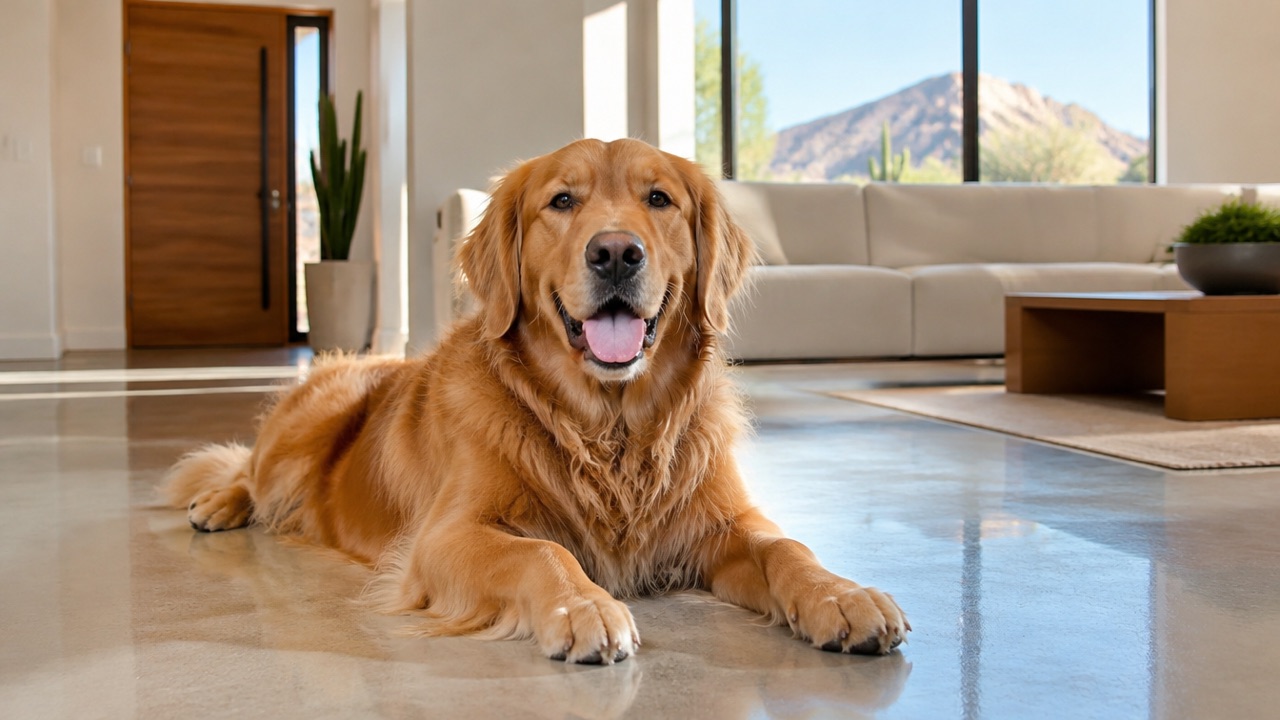
Are epoxy floors safe for pets? Yes, once the coating has fully cured, an epoxy floor is a hard, inert surface that is safe for dogs and cats to live on. The real risks are narrower than most homeowners fear: the first several days of cure, a glossy finish that is slippery on claws, and the wrong cleaner. If you are weighing a floor for a home with animals, our residential epoxy flooring in Phoenix service builds each system around these three points, and this guide explains what to specify and what to avoid.
Quick answer: A cured epoxy floor does not off-gas in any way that harms animals, it does not absorb urine, and it cleans with a pH-neutral cleaner. Keep pets out of the space for the full cure window, choose a satin or lightly textured topcoat so claws can grip, and avoid acidic or bleach-heavy cleaners.
| Pet concern | Risk level | What to do |
|---|---|---|
| Fumes during installation | Real, short-term | Keep animals out until the cure window ends |
| Slipping on gloss | Real, ongoing | Specify satin or a light anti-slip additive |
| Scratches from claws | Cosmetic only | Satin finish, renewal clear coat later |
| Chemicals in the cured film | Negligible | Ask for the product data sheet |
| Accidents and odor | Low | Seamless surface wipes clean |
| Cleaner residue | Avoidable | pH-neutral cleaner, warm water |
1. Is Epoxy Safe for Pets Once It Has Cured?
Yes. A fully cured epoxy or polyaspartic floor is a cross-linked plastic film, and the chemistry that made it hazardous in the bucket has been consumed in the reaction. The film does not shed particles, it does not leach, and it does not absorb anything an animal might lick off the surface.
The caution period is the installation and early cure. Two-part resins release solvents and reactive vapors while they harden, and an animal with a small body and a nose near the floor breathes more of that air than a person standing upright. This is why the rule is complete separation, not just keeping pets off the wet floor, until the installer confirms the floor is cured and the space has been ventilated.
Ask your installer for the product data sheet and the safety data sheet for each coat. A low-VOC formulation is available for most residential systems, and the data sheet states the VOC content in grams per liter so you are comparing numbers, not marketing language. Reading the sheet is a two-minute check and it tells you more than any general reassurance.
2. Traction: Why a Gloss Floor Is Hard on Dog Claws
A high-gloss epoxy floor is slippery for dogs because claws grip texture, and a glossy clear coat has almost none. Puppies, large breeds, and older dogs with weak hips are affected most, and they show it by splaying their legs, skating through doorways, or avoiding the room entirely.
Traction is measured as a coefficient of friction, and the wet and dry values differ a lot. A dry gloss floor can feel fine under a shoe and still be unforgiving to a claw, because a claw is a hard point with very little contact area. What helps is surface texture that the claw tip can catch, not a higher friction number on a data sheet.
- Satin or matte topcoat: Reduces the mirror finish and adds a fine micro-texture that claws can hold. This is the usual recommendation for a household with dogs.
- Light anti-slip additive: Fine aggregate broadcast into the final coat gives a stippled surface. It is more grip than satin, and it is still easy to clean.
- Flake broadcast: A full flake system has natural relief from the flake edges under the clear coat, so it offers more traction than a smooth solid-color floor.
- Area rugs on high-use paths: A rug at the door and the food bowl handles the two places where dogs accelerate and turn.
Choose the finish before the install, because changing it afterward means another coat. For a broader look at how each finish behaves in a living space, see our guide to residential epoxy pros and cons by room, which covers where a smooth floor works and where it does not.
3. VOCs During Installation and How Long to Keep Animals Away
Keep pets out of the space for the full cure window, which is typically five to seven days for a traditional epoxy and shorter for a fast-cure polyaspartic. The wait is about vapors and tack, not about the floor being dangerous afterward.
VOC stands for volatile organic compound, the solvents and reactive components that leave the film as it hardens. Most of the release happens in the first day or two, but the floor continues to cure for days, and animals that walk on a floor that is dry to the touch can still pick up soft coating on their paws and then lick it. Full separation avoids that entirely.
| Stage | Typical timing | Pets |
|---|---|---|
| Grinding and prep | Day 1 | Out of the house, dust and noise |
| Coating application | Day 1 to 2 | Out of the house, vapors |
| Light foot traffic | 24 to 48 hours | Still out |
| Full cure, traditional epoxy | 5 to 7 days | Back after ventilation |
| Full cure, fast-cure polyaspartic | Shorter, per product | Follow the installer's data sheet |
In Phoenix the practical answer is to board the animals or move them to a bedroom with its own door during the work, then ventilate the space with fans and open doors before they return. Summer heat makes this easier because the garage or room is already moving air, and it also speeds the cure, but it does not change the rule about separation. For an attached garage that opens into the house, ask the installer how they will isolate the door, since vapors move into the living space through it.
4. Scratch Resistance and What Claws Actually Do to a Coating
Claws leave fine surface marks on a gloss clear coat over time, but they do not penetrate the system or reach the slab. The marks are most visible under raking light, such as a low sun through a window in the late afternoon.
Abrasion resistance is tested under ASTM D4060, the Taber abrasion test, which rubs a weighted wheel on the coating and records the weight lost. A floor that performs well in the test resists wear from foot traffic and moving furniture. It is still a coating, and a hard point like a claw can burnish a dark clear coat or leave fine lines in it, in the same way a key leaves lines on a glossy countertop.
Three choices reduce how much the scratches show:
- A satin finish hides marks because the surface already scatters light, so fine lines blend in rather than reflecting as bright streaks.
- A flake or metallic system has a busy pattern underneath that distracts from surface wear.
- A renewal clear coat can be applied after several years to refresh the top film without redoing the floor. It is a light abrasion and a new topcoat, not a full replacement.
Keeping nails trimmed is the cheapest protection of all, and it helps the dog's own joints too. Do not expect a floor to be scratch-proof, and be wary of any contractor who says it is.
5. Cleaning Products That Are Safe Around Animals
A pH-neutral floor cleaner diluted in warm water handles almost everything and leaves no residue that an animal might ingest. Dogs and cats lick floors, paws and each other, so whatever stays on the surface ends up in their mouths.
Avoid vinegar and citrus-based cleaners, which are acidic and dull the finish over time, and avoid using bleach on a regular basis. Quaternary ammonium disinfectants, common in commercial products, leave a film and are not what you want a cat's paws walking through. Where a disinfectant is needed after an illness, use it once, then rinse the floor with clean water and let it dry before the animal returns.
The routine itself is simple. Sweep or dust-mop daily if there is shedding, damp-mop weekly with the neutral cleaner, and wipe spills as they happen. The full maintenance routine, including what to do about hard-water spotting in Arizona homes, is covered in our guide on how to maintain epoxy floors in Arizona, so it is not repeated here.
6. Accidents, Odor and Why a Seamless Floor Helps
A seamless epoxy floor does not absorb urine, so an accident wipes up completely and does not leave odor in the material. This is a real advantage over carpet, grout lines and unsealed concrete, and it is a major reason homeowners with pets choose a resinous floor.
Unsealed concrete is porous. Urine soaks into it, and the odor can return in humid weather long after the surface looks clean. Tile has grout lines that hold liquid and bacteria. A continuous coating has neither, so the surface is the only place an accident can be, and a wipe with the neutral cleaner removes it.
That seamless quality extends to the cove base where the floor meets the wall, which is where liquids collect in a laundry room, mudroom or kitchen. If your pet has a feeding station or a washing corner, our guide to residential interior epoxy for kitchens and laundry rooms explains how to detail those areas so water stays out of the wall.
The garage is the other pet zone, particularly for dogs that sleep or wait there. If that is your setup, the epoxy garage floor Phoenix page describes the systems with a textured finish, which also addresses traction on a smooth slab that gets wet.
7. Phoenix Factors for Pet Owners
Heat shapes the pet question in Phoenix more than most places, because animals spend more time indoors and in the garage during summer, and installers work around slab temperature.
- Summer slab temperature: A garage slab can run hot enough to shorten the working time of the coating, so crews schedule early starts. The cure is fast, but the separation rule is unchanged.
- Indoor air: Because homes run air conditioning for months, ventilation during the cure window needs to be deliberate, with fans and an exhaust path.
- Hard water: Maricopa County water leaves mineral spotting on glossy floors near water bowls, which a satin finish and a quick wipe reduce.
- Outdoor paws: Dogs track dust and fine grit indoors, and a doormat at the entry saves the finish from scuffing.
None of these is a reason to skip epoxy. They are the reasons to plan the finish, the schedule and the cleaner before the first coat goes down.
8. Frequently Asked Questions
Get a Free Quote for a Pet-Friendly Floor
Tell us about your animals and your space, and we will scope a finish with the traction and cure schedule your household needs.